Design Insights & Furniture Guides
Expert advice, custom upholstery guides, and home styling inspiration from Houston's furniture craftsmen.
Choosing among the Top 10 Custom Accent Chairs Manufacturers Worldwide requires more than attractive showroom photography. A chair may look impressive online, yet its frame, foam density, stitching, and delivery process decide its real value. This guide examines manufacturers that serve residential, hospitality, office, and retail projects. It focuses on practical performance, not only visual appeal.
Our evaluation considers design capability, material selection, production experience, customization range, quality control, and international service. We look for details such as kiln-dried hardwood frames, reinforced joints, high-resilience foam, durable upholstery, and carefully finished seams. Fabric sampling matters. So does the manufacturer’s ability to reproduce a color consistently across a large order.
Reliable suppliers should explain lead times, minimum order quantities, warranty terms, packaging methods, and installation support. Certifications and documented testing can also strengthen buyer confidence, although requirements differ by market. Customer feedback, factory communication, and project references provide useful evidence. Still, no manufacturer is perfect. Some offer excellent craftsmanship but limited fabric choices. Others provide flexible customization while requiring longer production schedules.
That trade-off deserves attention. A bold boucle chair may suit a boutique lobby, but it can demand careful maintenance in busy spaces. A compact velvet design may photograph beautifully, yet its comfort depends on seat depth and cushion support. By comparing these practical details, this overview helps buyers identify Custom Accent Chairs manufacturers that match their budget, design goals, and operating conditions. The ranking should guide research, not replace direct questions, sample approval, or professional specification review.
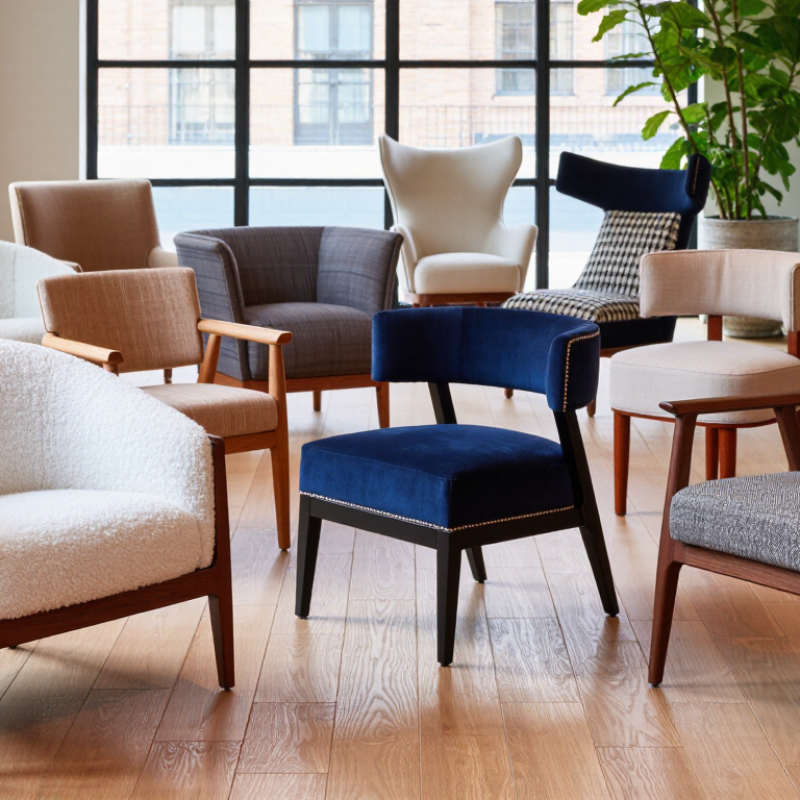
The global custom accent chair market serves residential, hospitality, workplace, and boutique commercial interiors. Demand is shaped by room size, seating comfort, delivery capacity, and local design preferences. North America favors larger silhouettes, deep cushions, and stain-resistant upholstery. European buyers often request compact frames, refined tailoring, and lower environmental impact. Asia-Pacific shows growing interest in flexible furniture for apartments, hotels, and mixed-use developments.
Material selection affects durability, appearance, and shipping weight. Kiln-dried hardwood can support strong frames, while engineered plywood helps control cost and shape consistency. High-resilience foam provides daily comfort, but its density should match expected use. Wool blends, treated polyester, leather, and recycled textiles serve different performance needs. I would request abrasion results, foam specifications, fabric composition, and frame warranties before comparing manufacturers.
Regional compliance also matters. Upholstery may require different fire, chemical, labeling, or sustainability documentation across markets. Custom manufacturers should provide construction drawings, sample approvals, packaging details, and reliable production timelines. Small details matter, such as reinforced corner blocks and removable covers. Yet no ranking is perfect. A manufacturer with excellent craftsmanship may lack fast regional support. Another may offer attractive pricing but limited material traceability. Buyers should inspect samples, test comfort, and review production records before placing large orders.
Ranking Criteria: Customization, Quality, Capacity, Certifications, and Lead Times
A credible ranking should measure more than showroom appearance. Grand View Research estimated the global furniture market at approximately US$516.6 billion in 2022, with a projected 5.2% CAGR from 2023 to 2030. That growth increases supplier choice, but also makes verification harder. For custom accent chairs, we examine fabric libraries, foam densities, frame options, dimensions, stitching, and prototype control. Small details matter. A two-millimeter seam shift can change the chair’s visual balance.
Small details matter. A two-millimeter seam shift can change the chair’s visual balance.
Quality requires documented procedures, not attractive photographs. ISO 9001 certification can indicate a controlled quality-management system, while FSC certification supports responsible wood sourcing. Textile certifications, such as OEKO-TEX Standard 100, help assess harmful-substance testing. These credentials do not guarantee perfect craftsmanship. They only provide useful evidence. We also inspect kiln-dried timber, joint construction, load testing, and packaging performance.
Capacity is judged through monthly output, equipment, workforce stability, and subcontracting transparency. Lead times must include sampling, material approval, production, inspection, and shipping preparation. Supplier declarations should match purchase-order records. Sometimes, they do not. That is a warning.
A practical ranking therefore favors manufacturers that provide production schedules, batch photos, inspection reports, and realistic recovery plans. The fastest quotation is not always the fastest delivery. A delayed fabric approval can add weeks, even when factory capacity appears strong.
For custom accent chairs, international compliance begins with the test method, not the fabric swatch. ANSI/BIFMA X5.4 evaluates lounge and public seating through strength, stability, and durability testing. Its durability protocol commonly reaches 100,000 loading cycles, exposing loose joints, weak fasteners, and foam compression. That figure matters for hotel lobbies and waiting areas. It may be excessive for occasional home use, but manufacturers should explain the design choice clearly.
EN 12520 focuses on domestic seating safety and durability. Its seating tests commonly use 25,000 cycles, while armrest performance receives separate attention. ISO 7173 provides methods for measuring chair strength and durability, but it does not function as a complete pass-or-fail specification. This distinction is often missed.
Independent laboratory reports should record load levels, cycle counts, failure points, and sample construction. A credible report also identifies timber moisture, metal thickness, foam density, and upholstery attachment. BIFMA’s industry statistics and standards publications provide useful North American benchmarks, while CEN documents support European evaluation practices. However, test results are not always comparable across regions. Different loads, fixtures, and chair geometries can change the outcome.
One uncomfortable truth remains. A chair may pass testing and still feel unstable on an uneven floor. Custom manufacturers should therefore combine laboratory evidence with prototype inspections and user trials. Small details matter: a 3-millimeter frame gap, a loose leg insert, or compressed edge foam can become a visible defect within months.
| Rank | Anonymous Manufacturer Profile | Primary Manufacturing Region | Custom Accent Chair Focus | Typical Customization Scope | Indicative MOQ | Typical Lead Time | Common Material Platform | Relevant Industry Benchmark | Recommended Compliance Evidence |
|---|---|---|---|---|---|---|---|---|---|
| 1 | Benchmark Profile 01 | East Asia | High-volume upholstered accent seating for hospitality and residential projects | Dimensions Upholstery Foam density Leg finish | 50–100 units | 8–14 weeks | Hardwood or engineered-wood frame, molded foam, fabric or leather upholstery, metal or wood legs | ANSI/BIFMA X5.4 for lounge and public seating; EN 12520 for domestic seating; ISO 7173 for chair strength and durability evaluation | Independent laboratory report, construction drawings, material declarations, and production inspection records |
| 2 | Benchmark Profile 02 | South Asia | Hand-finished upholstered chairs with textile, leather, and natural-material options | COM/COL fabrics Stitching Piping Wood stain | 25–75 units | 10–16 weeks | Kiln-dried hardwood, plywood components, polyurethane foam, cotton or polyester textiles, brass or steel fittings | EN 12520 and ISO 7173 are commonly used for residential seating strength and durability assessment; ANSI/BIFMA X5.4 may be requested for commercial projects | Material test certificates, upholstery composition data, prototype approval, and third-party load testing |
| 3 | Benchmark Profile 03 | Western Europe | Design-led accent chairs for contract, boutique hospitality, and premium residential interiors | CAD revisions Ergonomics Fire performance Surface finish | 20–50 units | 10–18 weeks | Certified timber or plywood, high-resilience foam, wool blends, recycled polyester, powder-coated or polished metal | EN 12520:2010 is the principal domestic seating reference; ISO 7173 provides a recognized strength and durability test framework; ANSI/BIFMA X5.4 supports North American commercial specifications | Accredited laboratory test report, technical file, upholstery specification, and traceability documentation |
| 4 | Benchmark Profile 04 | North America | Commercial lounge and guest seating for offices, healthcare, education, and public spaces | COM approval Seat height Base options Performance coatings | 10–50 units | 8–16 weeks | Engineered-wood or metal substructure, commercial-grade foam, contract textiles, steel or aluminum bases | ANSI/BIFMA X5.4-2020 is the primary North American benchmark for lounge and public seating; EN 12520 and ISO 7173 may be added for international projects | ANSI/BIFMA test report, product specification sheet, flammability documentation where required, and quality-control records |
| 5 | Benchmark Profile 05 | East Asia | Flat-pack and semi-assembled accent chairs optimized for e-commerce and retail distribution | Packaging Colorways Leg design Assembly method | 100–300 units | 6–12 weeks | Engineered wood, steel hardware, molded polyurethane foam, woven polyester, detachable solid-wood or metal legs | EN 12520 and ISO 7173 are relevant for domestic chair durability; ANSI/BIFMA X5.4 may apply when the same product is specified for public or commercial use | Prototype test record, carton-drop testing, assembly instructions, hardware specification, and finished-product inspection |
| 6 | Benchmark Profile 06 | Eastern Europe | Wood-framed accent chairs with traditional joinery and small-batch production | Wood species Joinery Carving Upholstery | 15–40 units | 12–20 weeks | Solid beech, ash, oak, or plywood; webbing or springs; resilient foam; natural or synthetic upholstery coverings | EN 12520 is applicable to domestic seating strength, durability, and safety requirements; ISO 7173 is a recognized supporting test method | Timber sourcing information, joinery inspection, durability test report, finish specification, and batch records |
| 7 | Benchmark Profile 07 | Southeast Asia | Rattan, cane, woven, and mixed-material accent seating for indoor and covered outdoor settings | Weave pattern Frame color Cushion fabric Seat dimensions | 50–150 units | 10–18 weeks | Solid wood or metal frame, natural cane or synthetic wicker, foam cushions, solution-dyed or coated textiles | ANSI/BIFMA X5.4, EN 12520, and ISO 7173 can be used to define structural and durability testing, subject to the intended indoor or outdoor application | Frame load testing, weave attachment inspection, coating or weathering data, cushion material certificates, and sampling plan |
| 8 | Benchmark Profile 08 | Latin America | Leather and performance-fabric accent chairs for hospitality, restaurants, and residential interiors | Leather grade Embossing Foam firmness Metal finish | 25–100 units | 8–16 weeks | Hardwood or steel frame, molded or cut foam, leather or coated fabric, steel, aluminum, or wood base | ANSI/BIFMA X5.4 is frequently specified for contract seating; EN 12520 and ISO 7173 provide internationally recognized domestic seating references | Leather or textile performance data, structural test report, foam specification, seam inspection, and final quality report |
| 9 | Benchmark Profile 09 | Middle East and North Africa | Project-based bespoke chairs for hotels, villas, restaurants, and luxury commercial interiors | Full bespoke sizing Decorative details Custom metalwork Mock-up approval | 10–30 units | 12–24 weeks | Hardwood, plywood, metal, high-resilience foam, velvet, leather, decorative trim, and plated or powder-coated components | The applicable benchmark depends on the destination market: ANSI/BIFMA X5.4 for North American contracts, EN 12520 for European domestic seating, and ISO 7173 for strength and durability testing | Approved shop drawings, first-article inspection, independent test report, fire-performance documentation where specified, and delivery inspection |
| 10 | Benchmark Profile 10 | Oceania | Sustainability-focused accent chairs using recycled, renewable, and low-emission materials | Recycled content Repairability Fabric selection Disassembly | 20–75 units | 10–18 weeks | Certified or recycled timber, recycled steel, bio-based or recycled foam options, recycled polyester, wool, and low-VOC finishes | ANSI/BIFMA X5.4 supports commercial seating assessment; EN 12520 and ISO 7173 are useful international references for domestic chair strength and durability | Third-party structural testing, recycled-content or chain-of-custody documentation, chemical declarations, repair instructions, and product traceability |
Note: The profiles are anonymized benchmark categories rather than disclosed company records. MOQ, lead-time, and customization figures are indicative industry ranges and should be verified in a supplier quotation. ANSI/BIFMA X5.4, EN 12520, and ISO 7173 are test and performance references; their applicability depends on the product design, market, intended use, and required test protocol.
The top 10 custom accent chair manufacturers worldwide are best compared through design range, minimum order quantity, and production scale. Grand View Research’s 2024 upholstered furniture analysis indicates steady market growth of roughly 5% annually through 2030. That demand favors suppliers offering curved backs, boucle upholstery, recycled fabrics, metal bases, and contract-grade foam. Design flexibility matters when a project needs one chair, not one thousand.
MOQ separates workshops from export-ready factories. Smaller manufacturers may accept 20–50 units per style, while larger producers often request 100–300 units for customized fabric, color, or frame changes. Some suppliers provide stock frames with lower MOQs, then adjust covers locally.
Practical buyers should request a physical sample, foam density, fabric abrasion results, and packaging photos. Small details matter.
Production scale still affects consistency. The top tier usually operates several assembly lines and produces thousands of chairs monthly. The International Trade Centre’s furniture trade data shows strong cross-border demand, but public factory figures remain incomplete. That weakness deserves attention. A large capacity claim proves little without shipment records, quality-control procedures, and realistic lead times.
CSIL’s global furniture outlook also highlights continued pressure on logistics and material costs. Manufacturers with diversified suppliers and documented inspections are therefore more reliable, even when their catalogues look less impressive.
Some rankings will remain subjective. Procurement teams should score customization, MOQ, monthly output, sampling speed, and defect handling separately.
Comparing the top 10 custom accent chair manufacturers requires more than visual appeal. Upholstery choices affect comfort, cleaning, and service life. Performance velvet suits hospitality areas, while tightly woven wool blends resist daily abrasion. The Furniture Industry Research Association recommends testing fabric durability, seam strength, and colorfastness before approval. Grand View Research valued the global furniture market at approximately USD 516.66 billion in 2023, showing the scale of buyer choice. Regional production also matters. European workshops often emphasize traceability, North American makers commonly offer shorter domestic delivery, and Asian factories may provide broader customization at competitive prices.
Dimensions can change the buying decision quickly. A chair measuring 760 millimeters wide needs more room than showroom photographs suggest. Check seat height, arm width, seat depth, and carton dimensions. BIFMA seating standards provide useful safety benchmarks, but they do not guarantee personal comfort. Pricing should include fabric grade, foam density, frame material, sampling, freight, and replacement parts. A low quotation may hide costly logistics. I would not assume the cheapest offer is inefficient; sometimes it reflects better production scale.
Tips: Request a physical fabric swatch and one prototype before ordering ten units. Ask for recycled-content evidence, wood certification, and repair instructions.
Textile Exchange’s Materials Market Report 2024 highlights continuing growth in preferred and recycled fibers, yet “sustainable” claims still require verification. Compare kilograms of packaging, expected delivery emissions, and warranty length. Sustainability is not only a material label. It is also how long the chair remains useful. That point is easy to miss.
Demand depends on room size, comfort, delivery capacity, and regional design preferences. Flexible furniture suits apartments, hotels, offices, and boutique interiors.
North American buyers often prefer larger frames, deep cushions, and stain-resistant upholstery. European buyers often request compact shapes and lower environmental impact.Asia-Pacific demand is growing.
Kiln-dried hardwood supports sturdy frames. Engineered plywood controls cost and shape consistency. High-resilience foam improves daily comfort when its density matches usage.
Request fabric composition, abrasion results, and cleaning information. Wool blends, treated polyester, leather, and recycled textiles serve different performance needs.Looks matter, but performance matters more.
Smaller workshops may accept 20–50 units per style. Larger factories often request 100–300 units for custom fabrics, colors, or frame changes.Stock frames may allow smaller orders.
Larger facilities may produce thousands of chairs monthly across several assembly lines. However, capacity claims need shipment records, inspection procedures, and realistic lead times.Big numbers prove little.
Buyers should request construction drawings, sample approvals, packaging details, production schedules, and relevant regional compliance documents.Requirements vary by market.
Score customization, minimum order quantity, output, sampling speed, defect handling, and material traceability separately. Inspect physical samples and test comfort before placing large orders.No ranking is perfect.
This guide to Custom Accent Chairs provides a practical overview of the global market, covering key regions, material choices, manufacturing capabilities, and buyer expectations. It explains how leading manufacturers can be evaluated through customization options, product quality, production capacity, certifications, minimum order quantities, and lead times. The article also introduces relevant industry benchmarks, including ANSI/BIFMA X5.4, EN 12520, and ISO 7173, helping buyers assess durability, safety, and performance more consistently.
A worldwide comparison examines manufacturers by design range, upholstery selection, dimensions, pricing, sustainability practices, and production scale. It also highlights how regional strengths and supply capabilities may affect project planning, shipping, and communication. Whether sourcing for hospitality, commercial interiors, residential developments, or specialized projects, buyers can use the comparison framework to identify suitable Custom Accent Chairs based on their design requirements, budget, order volume, quality standards, and delivery schedule.