Design Insights & Furniture Guides
Expert advice, custom upholstery guides, and home styling inspiration from Houston's furniture craftsmen.
Choosing among the 10 Best Handcrafted Hardwood Furniture Suppliers requires more than attractive photographs. Handcrafted Hardwood Furniture should combine durable materials, thoughtful design, and skilled construction. A walnut dining table may look impressive online, yet its value depends on grain selection, moisture control, joinery, and finish quality.
This guide examines suppliers through practical buying criteria. These include hardwood species, kiln-drying practices, construction methods, customization options, delivery protection, warranties, and customer service. Details matter. Look for dovetailed drawers, tight mortise-and-tenon joints, smooth table edges, and finishes that reveal the wood without hiding its character. A well-made oak chair should feel stable, not merely appear rustic in a showroom image.
Real experience also shapes the evaluation. Furniture is touched, moved, cleaned, and used daily. A cabinet must open evenly after seasonal changes. A dining surface should resist ordinary spills when properly maintained. Supplier reputation is considered through published policies, customer feedback, business history, and the clarity of product information. Claims without evidence deserve caution.
“Best” is subjective.
Some makers excel at custom sizing, while others offer stronger warranties or faster delivery. Wood color can vary significantly between samples and finished pieces. That can disappoint buyers expecting perfect uniformity. This guide recognizes those limitations instead of presenting every supplier as flawless. It aims to help readers compare craftsmanship, transparency, and long-term value before investing in furniture designed to serve for many years.
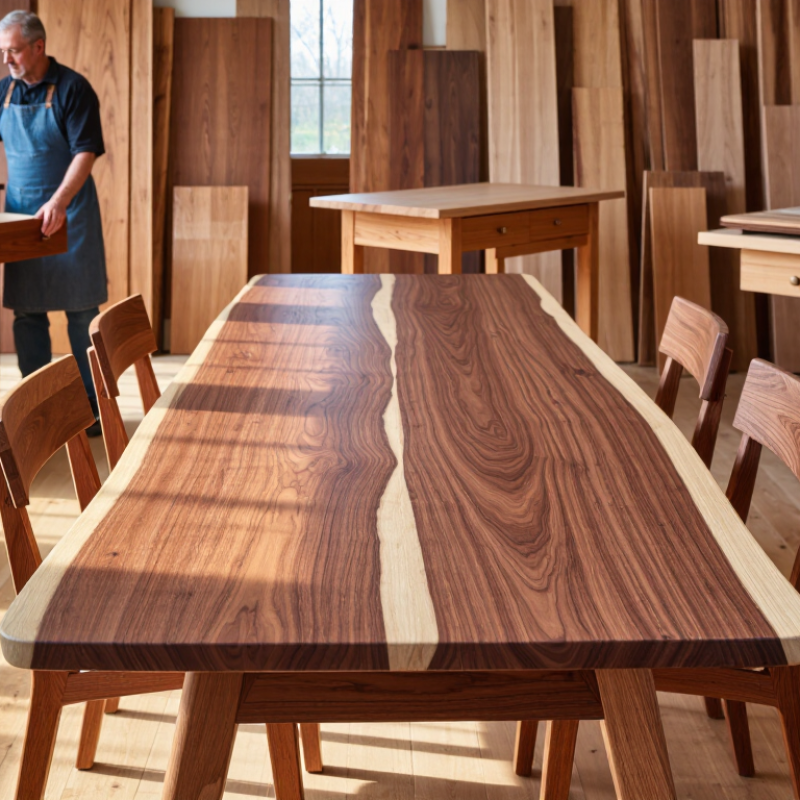
Handcrafted hardwood furniture is shaped by human judgment at every stage. A skilled maker studies the grain before cutting each board. This approach creates tables, beds, and cabinets with subtle differences in color and texture. No two pieces are perfectly identical.
Solid hardwood usually feels denser and warmer than veneered panels. Look for visible grain continuity, sturdy joinery, and smooth transitions between surfaces. Dovetail drawers, mortise-and-tenon joints, and carefully fitted legs often indicate thoughtful construction. A reliable supplier should explain the wood species, moisture control, finishing process, and expected maintenance. Clear details matter.
Wood moves with humidity.
In my experience, small variations can make handmade furniture feel honest. However, uneven gaps, unstable legs, or rushed sanding should not be excused as craftsmanship. That distinction deserves attention. Responsible makers also discuss timber sourcing and allow the wood to acclimate before final assembly. Natural oils, waxes, and low-sheen finishes can preserve the grain, but they still need periodic care. Buyers should inspect samples in natural light and ask how repairs are handled. Even excellent work may develop marks over time, especially in busy homes. That is not failure, but it does require realistic expectations.
Handcrafted hardwood furniture is valued for its natural grain, structural strength, repairability, and long service life. The chart compares the Janka hardness of commonly used hardwood species, measured in pounds-force (lbf). A higher value generally indicates greater resistance to dents and everyday wear, while design, joinery, finish, and craftsmanship also strongly influence furniture performance.
Evaluating a handcrafted hardwood furniture supplier requires more than inspecting attractive photographs. Ask where the timber comes from, how it is dried, and whether each board can be traced to a legal source. The FAO Global Forest Resources Assessment 2020 reported 4.06 billion hectares of global forest area, while 178 million hectares disappeared between 1990 and 2020. Responsible sourcing is not a decorative claim. Request chain-of-custody evidence, species details, and written harvesting information.
Moisture control deserves equal attention. The USDA Forest Products Laboratory’s Wood Handbook states that wood used inside heated buildings commonly reaches about 6% to 8% moisture content. Suppliers should explain kiln-drying methods, storage conditions, and seasonal movement. Look for stable joints, clean joinery, consistent sanding, and repairable finishes. Ask for samples. Small cracks can reveal poor preparation.
Check production capacity carefully. Handmade does not automatically mean careful. A reliable workshop should provide dimensions, lead times, warranty terms, and photographs of completed work. Industry experience matters, but it can also create blind spots. I would question suppliers that promise perfectly identical grain across every table; natural hardwood varies. That variation is useful evidence, not a defect. Still, uneven panels, loose joints, or strong chemical odors deserve investigation before payment. Supplier reviews help, but invoices, material records, and direct answers are stronger proof.
This guide profiles ten leading handcrafted hardwood furniture suppliers through practical buying criteria. Each supplier earns attention for material knowledge, documented craftsmanship, and consistent customer service. The strongest workshops explain wood origin, moisture control, joinery, and finishing methods clearly. That transparency matters. Beautiful photographs alone prove very little.
The sixth is known for low-sheen finishes that reveal natural grain. One workshop makes bedroom pieces with traditional mortise-and-tenon joints. Another combines ash frames with woven panels for lighter visual weight. The ninth supplier provides regional hardwood options and clear care instructions. The tenth focuses on small-batch stools, benches, and side tables, each inspected by hand.
Reliable suppliers also discuss limitations. Handmade surfaces may show knots, color shifts, or slight measurement differences. That is not always a defect. It can still challenge buyers expecting factory-level uniformity.
Ask about kiln drying, repair policies, delivery protection, and finish maintenance before ordering. I would also request a wood sample when possible. A screen can distort color badly. The best choice depends on room use, climate, budget, and patience, not reputation alone.
Choosing among the 10 best handcrafted hardwood furniture suppliers requires more than admiring photographs. Material selection affects durability, stability, and price. Oak and ash offer visible grain and strong everyday performance, while walnut provides deeper color but usually costs more. According to Grand View Research, the global furniture market reached approximately $516.66 billion in 2022, with growth projected through 2030. That expansion increases choice, but it does not guarantee quality. Ask whether suppliers use kiln-dried timber, disclose wood origin, and explain moisture control. The USDA Forest Products Laboratory notes that wood continually responds to surrounding humidity. Poorly conditioned boards can later cup, split, or loosen joints.
Craftsmanship should be judged through joinery, finish consistency, and repairability. Look beneath a table: tight mortise-and-tenon joints, even gaps, and a smooth underside reveal more than showroom lighting. Customization adds value when dimensions, edge profiles, finishes, and hardware are clearly priced. It becomes wasteful when every small change carries an unexplained surcharge. Pricing should separate timber, labor, finishing, delivery, and installation. A low quote may indicate thinner stock or rushed preparation. A high quote may reflect skilled labor, but not always. I have seen beautiful samples hide uneven drawer movement. Details matter. Request material samples, construction photos, lead times, and a written warranty before ordering. The comparison is imperfect, because regional labor rates and wood availability can distort otherwise fair prices.
| Rank | Anonymous Supplier Profile | Primary Hardwood Materials | Craftsmanship & Construction | Customization Options | Typical Lead Time | Indicative Price Range | Durability & Finish | Sustainability Indicators | Overall Rating |
|---|---|---|---|---|---|---|---|---|---|
| 1 | Premium American Workshop | Quarter-sawn white oak, walnut, cherry, and maple | Solid-wood construction, mortise-and-tenon joinery, hand-shaped edges, and carefully matched grain | Extensive: dimensions, leg profiles, drawer layouts, hardware, wood selection, and custom finishes | 10–18 weeks | $2,500–$9,000 per major piece | Conversion varnish or hand-rubbed oil; designed for 20+ years of indoor use with proper care | Often uses domestic hardwoods, kiln-dried lumber, and documented responsible-sourcing practices | ★★★★★ |
| 2 | Traditional European Cabinetmaker | European oak, ash, beech, walnut, and elm | Hand-cut dovetails, floating panels, traditional frame-and-panel construction, and detailed surface preparation | High: bespoke sizing, stain matching, carved details, brass or iron fittings, and room-specific designs | 12–24 weeks | $3,000–$12,000 per major piece | Hardwax oil, shellac, or water-based lacquer; repairable finishes and replaceable hardware | Commonly offers FSC-certified or locally sourced timber, depending on the workshop and region | ★★★★★ |
| 3 | Small-Batch Scandinavian Studio | European oak, ash, birch, and smoked oak | Clean-lined solid-wood frames, precision joinery, carefully sanded surfaces, and restrained detailing | Moderate to high: upholstery, dimensions, base design, color, and natural or pigmented finishes | 8–16 weeks | $1,800–$7,500 per major piece | Durable soap, oil, or low-VOC lacquer finishes; emphasis on easy maintenance and timeless design | Frequently prioritizes local timber, low-emission finishes, flat-pack efficiency, and long product lifecycles | ★★★★★ |
| 4 | Reclaimed Timber Specialist | Reclaimed oak, chestnut, pine, elm, and mixed salvaged hardwoods | Reinforced solid-wood construction, visible character marks, hand-planed surfaces, and structural stabilization | High: table sizes, edge profiles, leg styles, resin-free repairs, and tailored surface treatments | 6–14 weeks | $1,500–$6,500 per major piece | Matte oil, wax, or water-based finish; natural knots, nail marks, and color variation remain visible | Strong material-reuse profile; buyers should request information about timber origin and moisture testing | ★★★★☆ |
| 5 | Live-Edge Hardwood Studio | Walnut, oak, maple, acacia, and native salvaged hardwoods | Slab selection, moisture-controlled drying, stabilized cracks, concealed steel reinforcement, and hand-finished edges | High: slab choice, dimensions, edge treatment, base material, resin-free repairs, and finish sheen | 8–20 weeks | $1,800–$8,000 per table or desk | Oil and hardwax finishes provide a natural appearance; periodic renewal may be required | Can use urban trees or locally milled slabs; responsible suppliers disclose drying and sourcing practices | ★★★★☆ |
| 6 | Contemporary Joinery Workshop | White oak, walnut, maple, ash, and sapele | Precision-machined components combined with hand assembly, dovetailed drawers, and floating tops | Moderate: size, storage configuration, edge detail, wood species, and finish color | 6–12 weeks | $1,200–$5,500 per major piece | Conversion varnish, lacquer, or hardwax oil; strong resistance to everyday household wear | Often optimizes lumber use through digital cutting and may offer FSC-certified or locally sourced options | ★★★★☆ |
| 7 | Heirloom Dining Furniture Maker | Cherry, walnut, white oak, maple, and mahogany alternatives | Traditional mortise-and-tenon bases, breadboard ends, hand-fitted leaves, and solid drawer construction | High: table length, leaf system, chair dimensions, apron details, stain, and protective finish | 10–22 weeks | $2,000–$8,500 per dining set component | Durable catalyzed lacquer or oil-and-wax systems; designed for refinishing and long-term family use | Best practices include kiln-dried domestic lumber, repairable construction, and minimal use of composite panels | ★★★★☆ |
| 8 | Boutique Bedroom Furniture Builder | Oak, walnut, cherry, ash, and maple | Solid bed frames, reinforced corner blocks, dovetailed casework, and carefully fitted doors and drawers | Moderate to high: bed height, storage layout, hardware, headboard style, and finish selection | 8–16 weeks | $1,500–$6,000 per bedroom piece | Low-VOC oil, lacquer, or water-based finishes; surfaces are generally easy to clean and maintain | Long service life, replaceable hardware, and solid components reduce the need for frequent replacement | ★★★★☆ |
| 9 | Artisan Outdoor Hardwood Builder | Teak, white oak, black locust, ipe, and sustainably sourced acacia | Water-shedding joinery, corrosion-resistant fasteners, shaped components, and outdoor-rated assembly methods | Moderate: dimensions, seating configuration, cushion specification, slat spacing, and surface treatment | 6–14 weeks | $900–$5,500 per outdoor set or major piece | Natural weathering or exterior oil; requires seasonal cleaning and, for some species, periodic maintenance | Durable species can reduce replacement frequency; certification and plantation origin should be verified | ★★★★☆ |
| 10 | Value-Focused Custom Woodshop | Rubberwood, oak, ash, maple, walnut accents, and plantation-grown hardwoods | Solid-wood fronts and frames with selected engineered panels where dimensional stability is important | Moderate: standard dimensions, stain choices, hardware, shelf layouts, and limited design changes | 4–10 weeks | $700–$3,500 per major piece | Water-based lacquer or oil finish; suitable for normal residential use with routine care | May offer plantation-grown wood and efficient material use; certification varies by supplier | ★★★☆☆ |
Pricing and lead times are indicative ranges for comparable handcrafted hardwood furniture in the United States and Europe. Final costs vary according to dimensions, wood grade, hardware, finish, shipping, taxes, and installation requirements.
Choosing among handcrafted hardwood furniture suppliers requires more than admiring polished photographs. Ask where the timber comes from and how it is dried. Properly kiln-dried wood reduces cracking, twisting, and joint failure after delivery. Request moisture readings for your region.
Examine a sample joint closely. Tight mortise-and-tenon connections, smooth drawer movement, and consistent grain reveal careful workmanship. Ask whether the craftspeople build each piece or outsource production. Ask for proof. Clear answers matter.
Review the written quotation carefully. It should specify wood species, dimensions, finish, hardware, delivery dates, and repair terms. A reliable supplier explains natural variations, including knots, mineral streaks, and small color changes. These are not defects, but expectations should be agreed upon.
Speak with recent customers when possible. Their comments may reveal packaging quality, communication delays, or how problems were handled. A supplier with professional experience can explain maintenance in practical terms, such as using a soft cloth and avoiding standing water.
Do not choose solely by the lowest price. Cheap timber or rushed finishing may become expensive later. I used to value appearance too heavily; that judgment can miss weak joinery. Inspect the workshop, request progress photographs, and keep every specification in writing. Real craftsmanship should survive close questions.
Look beneath the table, not only at its polished top. Tight joints and even gaps suggest careful construction. A smooth underside helps. Photographs can mislead. Ask for construction photos before ordering.
Oak and ash offer strong performance and visible grain. Walnut gives richer color but often costs more. The best choice depends on use, climate, and budget. Personal taste still matters.
Kiln-dried timber has reduced moisture before construction. This can limit cracking, twisting, and loose joints after delivery. Ask for moisture readings suited to your region. Wood still reacts to humidity.
Usually, natural knots, mineral streaks, and color shifts are expected. Small measurement differences may also occur. Confirm these details before ordering. Handmade does not mean perfectly uniform.
It should list wood species, dimensions, finish, hardware, delivery dates, and repair terms. Costs should separate timber, labor, finishing, and delivery. Unclear surcharges deserve careful questions.
Ask for full-size drawings before cutting begins. Confirm dimensions, edge profiles, finishes, and hardware in writing. Custom work becomes wasteful when every tiny change costs extra. Measure your room twice.
Ask how the piece will be packaged and protected during transport. Confirm the repair policy and warranty details. Recent customers may reveal communication delays or damaged packaging. This evidence is useful.
Use a soft, dry cloth for routine cleaning. Wipe standing water quickly. Follow the maker’s finish instructions. Avoid harsh cleaners unless specifically approved. I once focused too much on appearance. That missed practical care.
Not necessarily. A low quote may reflect thinner timber or rushed finishing. A high quote does not guarantee better work. Request samples, lead times, and progress photographs. Compare details, not just totals.
This guide explores the defining qualities of Handcrafted Hardwood Furniture, including the character of natural wood, careful joinery, long-lasting construction, and the personal attention involved in creating each piece. It explains how handcrafted furniture differs from mass-produced alternatives and outlines the key factors buyers should consider when evaluating suppliers, such as wood sourcing, material quality, construction methods, finishing standards, customer service, warranties, and delivery practices.
The article also presents profiles of ten leading types of handcrafted hardwood furniture suppliers without focusing on brand names, helping readers compare their strengths in materials, craftsmanship, customization, design flexibility, and pricing. Finally, it offers practical advice for choosing the right supplier based on lifestyle, room requirements, budget, preferred wood species, desired style, and the level of personalization needed. By understanding these considerations, readers can make a confident and informed decision when investing in furniture designed for beauty, function, and lasting value.